
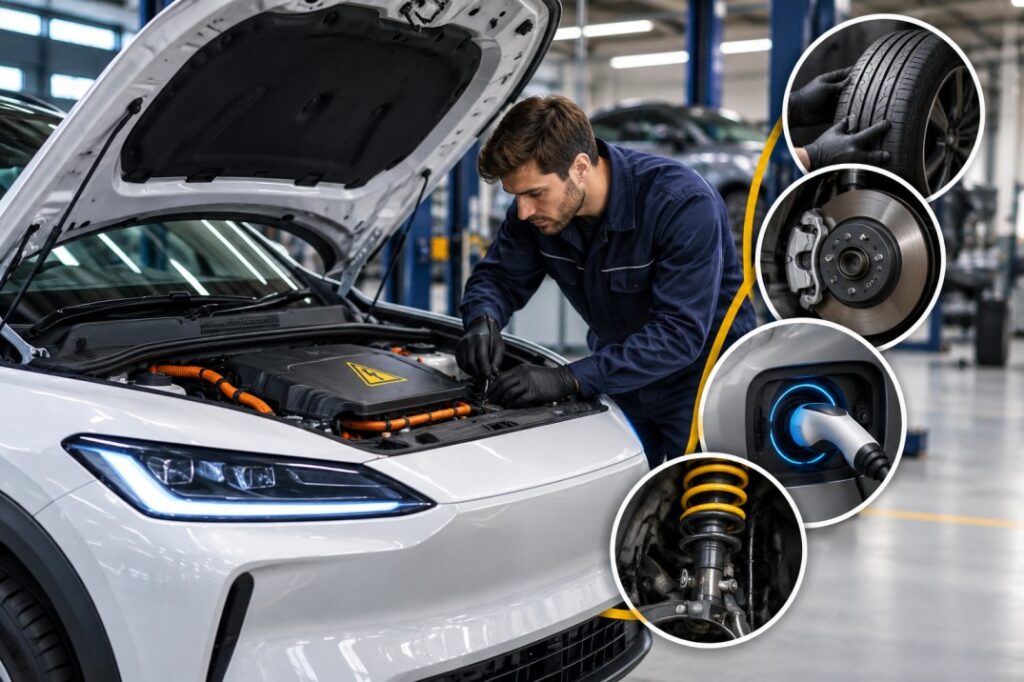
Electric cars are becoming a familiar sight on Australian roads, offering quiet performance, lower running costs and a different driving experience. However, many drivers believe electric vehicles are completely maintenance-free. A professional mechanic in Mordialloc can help identify problems with tyres, brakes and suspension, while regular car service in Mordialloc appointments remain important for keeping electric vehicles safe, reliable and ready for everyday driving.
Unlike traditional petrol and diesel vehicles, electric cars do not need engine oil changes, spark plug replacements or exhaust system repairs. While this reduces some maintenance requirements, it does not eliminate the need for regular inspections.
Ignoring essential maintenance can result in uneven tyre wear, reduced braking performance, electrical problems and unexpected repair expenses.
Here are seven common electric vehicle maintenance myths that every Australian driver should understand.
Myth 1: Electric Cars Never Need Regular Servicing
One of the biggest misconceptions about electric vehicles is that fewer moving parts mean no servicing is required.
Electric cars have simpler drivetrains than conventional vehicles, but they still contain many components that experience wear during everyday driving.
Tyres, brakes, suspension, steering systems, cabin filters and cooling components all require attention at different intervals.
Modern electric vehicles also rely on sophisticated electronic systems that monitor performance, temperature and vehicle safety.
Manufacturers such as Tesla, BYD, Hyundai, Kia, BMW, MG and Polestar provide maintenance recommendations for their electric models. These recommendations vary depending on the vehicle, driving conditions and kilometres travelled.
Following the recommended Logbook Service schedule helps ensure essential inspections are completed at the appropriate time.
Regular maintenance can also identify developing problems before they affect the vehicle’s handling, comfort or reliability.
Although an electric car may require fewer routine replacements than a petrol vehicle, skipping scheduled inspections is not a sensible way to save money.
Myth 2: Regenerative Braking Means Brake Pads Last Forever
Electric vehicles use regenerative braking to recover energy while slowing down.
Instead of relying entirely on conventional friction brakes, the electric motor helps reduce vehicle speed while returning some energy to the battery.
This technology can reduce brake pad wear, particularly during city driving.
However, regenerative braking does not completely replace traditional braking components.
Electric vehicles still use brake discs, pads, callipers, hydraulic systems and brake fluid.
In some circumstances, these components may experience corrosion or reduced movement because they are used less frequently.
Moisture, road debris and everyday environmental conditions can also affect braking components over time.
Drivers should pay attention to warning signs such as:
- Grinding, scraping or squealing noises when braking.
- Vibrations through the brake pedal or steering wheel.
- Reduced braking response.
- Unusual noises after the vehicle has been parked.
- Brake warning lights appearing on the dashboard.
Professional inspections and timely brakes repairs help maintain the condition of the braking system.
Electric vehicles may also use electronically controlled braking systems, making it important to follow the manufacturer’s recommended inspection and repair procedures.
A quieter driving experience should never lead owners to overlook brake safety.
Myth 3: Electric Vehicle Tyres Are No Different From Regular Car Tyres
Tyres are among the most important components of any electric vehicle.
They provide the connection between the vehicle and the road, influencing braking, handling, comfort and driving efficiency.
Electric vehicles can place different demands on tyres because of their weight distribution, instant torque delivery and, in some models, higher overall weight.
Rapid acceleration can contribute to tyre wear, particularly when drivers frequently use the vehicle’s full performance.
Incorrect tyre pressure and poor wheel alignment can also shorten tyre life.
Some electric vehicles use tyres designed to balance rolling resistance, load capacity, road noise and grip.
Choosing the right tyres is essential, especially when the manufacturer specifies particular sizes, load ratings or performance requirements.
Professional tyre sales services can help motorists compare suitable options based on their vehicle specifications and driving needs.
Regular tyre inspections should include checking:
- Tread depth and uneven wear patterns.
- Tyre pressure according to manufacturer recommendations.
- Sidewall damage and visible cracks.
- Wheel alignment and suspension condition.
- Tyre age and overall condition.
Timely tyre replacement is important when tyres become excessively worn, damaged or unsuitable for safe driving.
For electric vehicle owners, maintaining tyres in good condition can also help minimise unnecessary rolling resistance and support efficient energy use.
Myth 4: The Main Battery Is the Only Battery That Matters
Most electric vehicle owners focus on the large battery pack responsible for powering the electric motor.
However, many electric cars also contain a separate low-voltage auxiliary battery.
This smaller battery supports essential electrical functions such as vehicle control systems, lighting and other electronic components.
A failing auxiliary battery can cause unexpected problems, even when the main traction battery has plenty of charge remaining.
Depending on the vehicle, symptoms may include dashboard warnings, electrical faults or difficulty activating the vehicle.
Modern electric vehicles use different low-voltage battery arrangements, including conventional 12-volt batteries and lithium-based systems.
These batteries should be checked according to the manufacturer’s recommendations.
The main traction battery also requires appropriate temperature management.
Many electric vehicles use liquid cooling systems to control battery and electric drive temperatures during charging and driving.
Cooling system problems can affect charging performance, battery operation and overall vehicle reliability.
Maintenance requirements vary between manufacturers. Some systems require periodic coolant checks or replacement, while others have different service intervals.
Drivers should avoid attempting repairs involving high-voltage battery components.
These systems can remain dangerous even when the vehicle is switched off and must only be handled by appropriately trained personnel using suitable safety procedures.
Keeping both high-voltage and low-voltage systems in suitable condition is an important part of electric vehicle ownership.
Myth 5: Electric Cars Don’t Experience Suspension Problems
Electric vehicles may have advanced technology beneath the bonnet, but they still travel over the same roads as petrol and diesel cars.
Potholes, speed humps, uneven surfaces and everyday driving conditions place stress on suspension components.
Shock absorbers, control arms, bushes, ball joints and steering components can gradually wear over time.
The weight and design of certain electric vehicles may also influence suspension loading.
Suspension problems are not always immediately obvious.
Drivers may notice subtle changes in steering response, ride comfort or tyre wear before a more noticeable fault develops.
Common warning signs include:
- Knocking sounds when travelling over bumps.
- Uneven or excessive tyre wear.
- A steering wheel that feels off-centre.
- The vehicle pulling towards one side.
- Increased bouncing or reduced ride comfort.
- Unusual vibrations at particular speeds.
Wheel alignment is particularly important because incorrect alignment can affect handling and contribute to premature tyre wear.
A vehicle that travels smoothly in a straight line can still have developing suspension problems.
Regular inspections help identify worn components and determine whether repairs or adjustments are required.
Maintaining suspension and steering components also helps protect the tyres from unnecessary wear.
For motorists using electric vehicles on Melbourne’s busy suburban roads, these checks remain an essential part of responsible vehicle maintenance.
Myth 6: Electric Vehicles Don’t Need Safety Inspections
Electric vehicles still need to meet applicable road safety requirements, regardless of whether they use petrol, diesel or electricity.
Their braking systems, tyres, steering, suspension, lighting and other safety-related components must remain in suitable condition.
In Victoria, a roadworthy certificate may be required when selling, transferring or re-registering a vehicle, depending on the circumstances.
Electric vehicles are not automatically exempt from these requirements.
A roadworthy inspection assesses prescribed safety-related items to determine whether the vehicle meets the applicable minimum standards.
It is important to understand that a roadworthy inspection is not the same as a comprehensive mechanical inspection or a guarantee that a vehicle will remain trouble-free.
Some electric vehicles also require specific inspection procedures because of their high-voltage systems and unique construction.
Owners should confirm that the inspection provider is appropriately licensed and able to assess their particular vehicle.
Regular servicing between formal inspections helps motorists identify worn components and address developing concerns.
Safety should remain a priority regardless of the technology powering the vehicle.
Myth 7: Warning Lights Can Be Ignored If the Car Still Drives Normally
Modern electric cars use electronic monitoring systems to detect faults and communicate important information to drivers.
A warning message might relate to the traction battery, charging system, braking system, cooling components or electronic controls.
Some warnings indicate minor issues, while others require immediate professional attention.
The challenge is that electric vehicles can sometimes continue operating even after a fault has been detected.
Drivers may assume the problem is unimportant because the vehicle still accelerates, brakes and charges.
However, continuing to drive with an unresolved warning can sometimes make a problem worse.
Certain faults may eventually cause reduced vehicle performance, limited charging capability or an unexpected shutdown.
Drivers should follow the instructions displayed by the vehicle and consult the owner’s manual.
If a serious warning appears, particularly one involving a high-voltage fault, overheating or braking performance, the safest response may be to stop driving and arrange professional assistance.
Specialist diagnostic equipment may be required to identify the underlying cause.
Attempting to reset warning messages without understanding the fault can conceal a problem rather than resolve it.
Early diagnosis is often more practical than waiting for the issue to affect everyday driving.
Electric Car Servicing vs Petrol Car Servicing: What’s Different?
Electric and petrol vehicles share several maintenance requirements, but the differences are important.
A petrol vehicle depends on an internal combustion engine, meaning routine maintenance often includes engine oil, filters, spark plugs and other engine-related components.
A fully electric vehicle eliminates many of these conventional servicing tasks.
However, electric vehicles still require inspections of their mechanical and electrical systems.
Petrol and diesel vehicles commonly require:
- Engine oil and oil filter changes.
- Spark plug replacement where applicable.
- Exhaust system inspections.
- Engine-related fluid maintenance.
- Brake, tyre and suspension checks.
Fully electric vehicles commonly require:
- Tyre condition and pressure inspections.
- Brake system inspections.
- Steering and suspension checks.
- Cabin air filter maintenance.
- Low-voltage battery checks.
- Cooling system maintenance where specified.
- Manufacturer-recommended electrical system inspections.
The absence of an engine oil change does not mean an electric vehicle should remain unchecked for years.
Maintenance intervals depend on the manufacturer, model, age and driving conditions.
Owners should follow the vehicle’s specific service schedule rather than relying on general assumptions about electric cars.
Plug-In Hybrid Cars Need Even More Attention to Their Maintenance Schedule
Plug-in hybrid electric vehicles, commonly known as PHEVs, combine an electric motor and rechargeable battery with a conventional combustion engine.
This arrangement allows drivers to complete some journeys using electric power while retaining the flexibility of a petrol or diesel engine.
However, having two propulsion systems introduces additional maintenance considerations.
A plug-in hybrid may still need engine oil changes, filter replacements, cooling system inspections and conventional engine maintenance.
Its electric drive components also have their own inspection and maintenance requirements.
Even when the vehicle operates mostly in electric mode, the combustion engine must be maintained according to the manufacturer’s schedule.
Long periods of limited engine use do not automatically eliminate servicing requirements.
Drivers who own plug-in hybrids should pay particular attention to scheduled maintenance rather than assuming that electric driving reduces every service requirement.
Proper maintenance helps keep both propulsion systems functioning as intended.
How Often Should an Electric Car Be Serviced in Australia?
There is no single servicing interval that applies to every electric vehicle.
Some manufacturers recommend periodic inspections based on time, kilometres travelled or individual component condition.
Other manufacturers provide maintenance schedules that focus on specific items rather than a traditional fixed annual service.
Driving conditions can also influence how frequently components need attention.
For example, vehicles used for long daily commutes may accumulate tyre and suspension wear more quickly than cars driven occasionally.
Frequent short trips, coastal conditions, heavy traffic and poor road surfaces can also influence certain maintenance requirements.
Drivers should review their owner’s manual and manufacturer maintenance information to identify the correct schedule.
It is also sensible to arrange an inspection when unusual noises, vibrations, warning messages or changes in driving behaviour occur.
Waiting until the next scheduled appointment may not be appropriate when a safety-related problem develops.
Can Independent Mechanics Service Electric Vehicles?
Many routine maintenance tasks on electric vehicles can be carried out by suitably equipped independent automotive workshops.
Services such as tyre fitting, wheel alignment, suspension inspections and certain brake maintenance procedures may be available outside the manufacturer’s dealership network.
However, the work must be suitable for the vehicle and performed by personnel with the necessary training, equipment and technical information.
High-voltage battery repairs, specialised diagnostics and manufacturer-specific procedures may require additional qualifications or an authorised service provider.
In Australia, choosing an independent workshop for appropriate scheduled servicing does not automatically void a manufacturer’s warranty.
The work must meet applicable requirements, including relevant servicing procedures and suitable parts and fluids.
Maintaining accurate service records is also beneficial when selling the vehicle or reviewing previous maintenance.
Before booking, vehicle owners should provide the workshop with the make, model, year and details of the required work.
This allows the workshop to confirm whether the appropriate services are available.
Small Maintenance Problems Can Become Expensive Repairs
Electric vehicles can offer lower routine maintenance requirements, but neglected components may still lead to costly problems.
Worn tyres can reduce grip and affect driving safety. Poor wheel alignment can increase tyre wear. Brake corrosion may require attention when detected during an inspection.
Similarly, suspension problems can affect handling and potentially place additional stress on nearby components.
Electrical warnings and cooling system problems should also be investigated before they become more serious.
Preventative maintenance is not about replacing parts unnecessarily.
It involves understanding the vehicle’s condition, following manufacturer recommendations and addressing faults when there is a genuine need.
For electric car owners, this approach can help reduce unexpected disruptions while supporting long-term vehicle reliability.
Keep Your Electric Vehicle Road-Ready with Continental Mordialloc
Electric vehicles may be changing the future of driving, but regular maintenance remains an important part of vehicle ownership.
From tyres and wheel alignment to braking, steering and suspension, every component contributes to safety, comfort and everyday performance.
At Continental Mordialloc, we help motorists maintain their vehicles through professional automotive servicing, mechanical inspections, tyre services and wheel care. Our team can discuss your electric vehicle’s make, model and maintenance requirements to confirm suitable service options.
Our workshop welcomes enquiries from drivers across Aspendale, Moorabbin, Mordialloc, Dingley Village, Bentleigh, Parkdale, Mentone, Keysborough, Chelsea Heights, Waterways and Cheltenham.
Visit us at 23 Boundary Road, Mordialloc VIC 3195, or call 03 9590 9669 to discuss your vehicle’s maintenance needs and arrange an appointment.
Keeping up with essential maintenance today can help prevent unwanted surprises on the road tomorrow.