
If you’ve ever noticed your car drifting slightly to the left on a straight road, or your steering wheel sitting at a slight angle when you’re going dead straight, you’ve probably already felt the effects of misaligned wheels without knowing it.
Wheel alignment is one of those services that most Melbourne drivers know they should get — but rarely do until something forces the issue. A new set of tyres, an unusual vibration, or a mechanic flagging it during a service are usually what prompts the booking.
The problem with waiting is that misalignment doesn’t stay still. It quietly destroys your tyres, pushes up your fuel bill, and puts extra load on your suspension components — all while the car feels mostly normal. By the time the signs are obvious, you’ve already paid the price in rubber.
This guide explains exactly what wheel alignment is, the seven signs that your car needs one now, how often to book it in, and what you can expect when you bring your vehicle to a workshop in Braeside, Mordialloc, or the surrounding south-east Melbourne suburbs.
What Is a Wheel Alignment and What Does It Actually Do?
Wheel alignment is the process of adjusting the angles at which your tyres make contact with the road, bringing them back to the vehicle manufacturer’s exact specifications.
Your wheels are connected to your suspension and steering system at very precise angles. Three of these angles matter most:
Camber is the inward or outward tilt of the wheel when viewed from the front of the car. If the top of the tyre leans outward, that’s positive camber. Inward is negative. Even a fraction of a degree too far in either direction causes the tyre to wear heavily on one edge.
Toe refers to whether the fronts of your tyres point slightly inward (toe-in) or outward (toe-out) when viewed from above. This is the most common alignment issue and the most damaging to tyres — incorrect toe wears rubber fast and silently.
Caster is the angle of the steering axis when viewed from the side of the car. Caster affects steering feel and straight-line stability. If it’s off, the car feels vague or “floaty” at highway speed.
A full four-wheel alignment measures all three angles on all four wheels and adjusts them back to spec. The result is a car that drives straight, steers accurately, and wears its tyres evenly — exactly as the manufacturer intended.
7 Signs Your Car Needs a Wheel Alignment Right Now
1. Your Car Pulls to One Side
This is the most obvious sign and the one most drivers notice first. On a flat, straight road with no crosswind, let go of the steering wheel briefly and watch what happens. If the car drifts consistently to the left or right, your alignment is likely off.
A gentle drift is often normal on roads that are crowned (sloped for water runoff). But a definite, consistent pull toward one side — especially on a level surface like a car park or empty straight — is alignment.
2. Your Steering Wheel Isn’t Centred When Driving Straight
Look at your steering wheel when you’re travelling in a straight line. The centre badge should sit level. If the wheel is rotated even slightly — a few degrees clockwise or anti-clockwise — your toe settings are likely out.
This often happens after clipping a kerb or hitting a significant pothole. The car may still track straight, but the steering geometry is compensating unevenly, which puts stress on tyres and steering components.
3. Uneven Tyre Wear — Inside or Outside Edge Worn More
Run your hand across the tread of each tyre from the inside edge to the outside edge. If one side is noticeably more worn than the other, or if the inside shoulder is worn while the centre tread still looks new, that’s a camber or toe problem.
This is the costliest symptom to ignore. A set of quality tyres can cost $400–$800 to replace. An alignment service costs a fraction of that. Uneven wear means you’re replacing tyres months or even years earlier than necessary.
4. Tyre Feathering — One Direction Feels Rough, the Other Smooth
This one is less obvious but worth knowing. Run your palm slowly across the tread blocks in both directions. If it feels smooth going one way but rough or jagged going the other — like running your hand against the grain — that’s feathering. It’s caused by incorrect toe settings and is a reliable early indicator that alignment is out before the wear becomes visually obvious.
5. Steering Wheel Vibration at Highway Speeds
While vibration is more commonly associated with wheel balancing (weight distribution around the rim), severe misalignment can also cause a shimmy through the steering column, particularly at speeds above 80 km/h. If the steering feels unsettled on the Nepean Highway or while travelling on the Monash Freeway, and balancing hasn’t fixed it, alignment is the next thing to check.
6. You’ve Hit a Pothole or Clipped a Kerb
Melbourne’s south-east suburbs — including the industrial roads around Braeside, Cheltenham, and Mordialloc — have their share of pothole damage, speed humps, and tight kerbs in warehouse and shopping centre car parks. A single hard hit at low speed can knock toe and camber angles out of spec instantly.
Even if the car seems to drive fine afterwards, the alignment may have shifted enough to start wearing tyres without producing obvious symptoms. If you’ve had a significant impact with a kerb or pothole, a post-impact alignment check is worth the 45 minutes.
7. Your Car Has Covered More Than 10,000 Kilometres Since the Last Alignment
Even with no dramatic event, wheels drift gradually out of alignment through normal wear on suspension bushes, steering components, and road vibration. Most manufacturers and alignment specialists recommend a check every 10,000 kilometres or every 12 months — whichever comes first. If you can’t remember the last time your alignment was checked, it’s almost certainly overdue.
Wheel Alignment vs Wheel Balancing — What’s the Difference?
This is one of the most common sources of confusion among car owners, and it’s worth clearing up.
Wheel alignment adjusts the angles of your wheels relative to each other and to the road. It fixes pulling, off-centre steering, and uneven tyre wear. The adjustment is made to the suspension and steering components.
Wheel balancing addresses weight distribution around the wheel and tyre assembly. When a tyre is mounted, tiny weight imbalances between the rubber and the rim can cause vibrations, particularly at highway speeds. Balancing adds small counterweights to the rim to even out the distribution.
They address different problems. Alignment fixes geometry; balancing fixes vibration. Both contribute to even tyre wear and a smooth drive — and both should be part of your regular vehicle maintenance routine.
How Often Should You Get a Wheel Alignment in Melbourne?
The standard recommendation from tyre and auto specialists across Australia is every 10,000 kilometres or annually, whichever comes first. However, there are specific situations where you should book an alignment regardless of distance:
- After fitting new tyres — always align after new rubber to protect your investment from day one
- After any suspension or steering work — components shift when they’re replaced
- After hitting a significant pothole or kerb
- When you notice any of the seven warning signs above
- Before a long road trip — particularly relevant for Braeside and Mordialloc locals heading up the Hume or along the Great Ocean Road
What to Expect: The Alignment Process
A standard four-wheel alignment at a professional workshop in Melbourne’s south-east takes between 45 minutes and one hour. Here’s what happens:
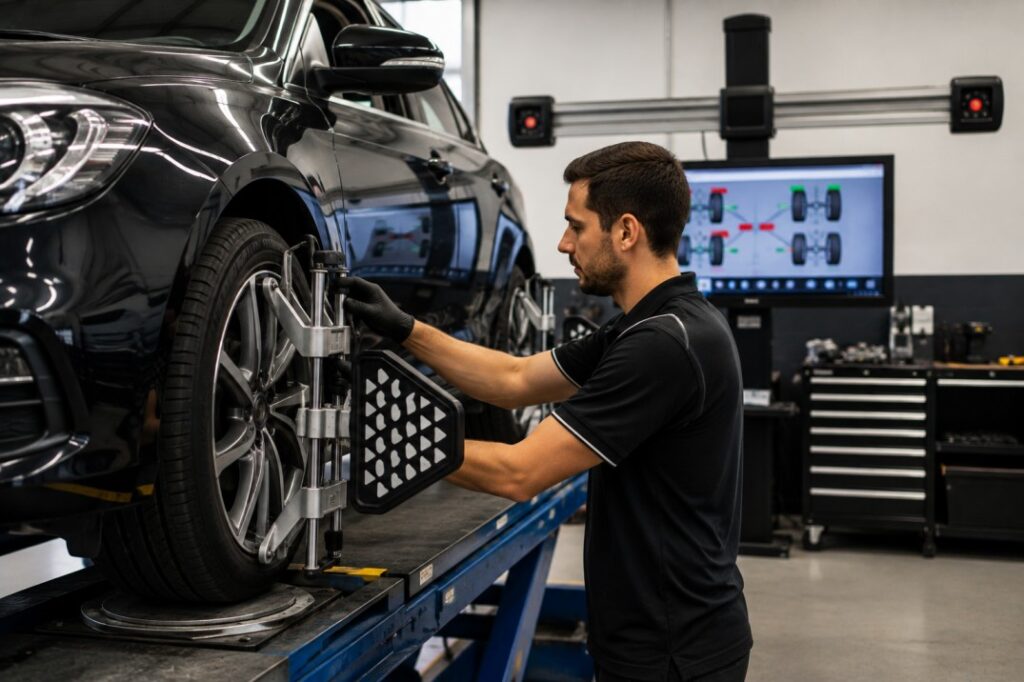
The technician places sensors or cameras on all four wheels, which feed angle data to a computer system. The software compares your vehicle’s current readings against the manufacturer’s specification database. Any angles outside tolerance are adjusted — typically via adjustment bolts or shims on the suspension components — until all four wheels sit within spec.
A good alignment service includes a pre-alignment check of your suspension and steering components. If a worn tie rod, damaged bush, or bent control arm is causing the misalignment, adjusting the angles without fixing the worn component won’t hold — the car will go out of alignment again quickly. A reputable workshop will flag any worn components before proceeding.
At Continental Mordialloc, every wheel alignment includes a pre-check of your steering and suspension for exactly this reason. We service all vehicle makes and models across Braeside, Mordialloc, Mentone, Cheltenham, Parkdale, and surrounding south-east Melbourne suburbs.
Wheel Alignment Cost — What to Expect in Melbourne’s South-East
A standard two-wheel (front) alignment in Melbourne typically costs between $80 and $120. A full four-wheel alignment — recommended for most modern vehicles, particularly AWD, 4WDs, and any car where the rear suspension is adjustable — costs between $100 and $180.
If you’re also fitting new tyres, many workshops offer alignment as part of a package. It’s always worth asking, because aligning immediately after new tyre fitment is the single best thing you can do to maximise your tyre investment.
Book Your Wheel Alignment Near Braeside — Continental Mordialloc
If you’re based in Braeside, Mordialloc, Mentone, Cheltenham, Parkdale, or Caringbah and your car is showing any of the signs above, our team at Continental Mordialloc can get you booked in and sorted quickly.
We offer:
- 4-wheel alignment for all vehicle makes and models including 4WDs and vans
- Pre-alignment suspension check included with every service
- Same-day service where possible
- Competitive pricing with no hidden fees
We also supply and fit tyres if your alignment check reveals your current rubber is too worn to realign effectively — and if you’re due for a roadworthy certificate, our licensed inspectors can combine both services in a single visit.
23 Boundary Road, Mordialloc VIC 3195 (serving Braeside and all south-east Melbourne suburbs)
Call us: 03 9590 9669
Mon–Fri: 8:30am–5:30pm | Sat: 8:30am–3:30pm